
John’s favourite
John’s favourite rock – I agonised over the choice since I love so many of the Anglesey rocks for so many different reasons but I finally settled on dolerite for two main reasons. First, the story it tells about earth processes and secondly, the way it has been used since earliest times.
I love the way dolerite is produced – by partial melting of the earth’s mantle, and the way as a liquid it finds a path up through the rocks of the crust until it finally cools and crystallises out as a solid occupying some form of crack amongst the rocks. Within our geopark there are two generations of dolerite, an ancient one dating back to the Carboniferous period, and a more modern only some 55 million years old. It is this younger one that fascinates me, telling a story of the opening of the Atlantic Ocean when the joint N American-European continent was torn apart. This dolerite originated in the magmas that were forming the new ocean plate but ran off into vertical tension cracks in the margins of the European half of the old plate forming dykes. A swarm of these dykes crosses Anglesey roughly from south to north.

The second reason is that in my work with archaeologists, I came across dolerite being used by ancient man in two ways – I assisted Gwynedd Archaeological Trust (now Heneb) with their excavation at Capel Eithin, Gaerwen and made thin sections (microscope slides) of several of the large Bronze Age cremation urns found there (you can see some of these in Oriel Mon). Almost all had used crushed dolerite to temper the clay to prevent cracking when firing. Later, when involved with the Ty Mawr hutgroup on Holyhead Mountain, we discovered a pile of “burnt stones” sometimes called “pot boilers”.

They are common on Neolithic sites which predate the development of pottery so it is assumed that they were used to transfer heat from a bonfire to a pit of water since there was no other practical way of heating water. What was stunning about this site was that ever “pot-boiler” was dolerite, yet there is no nearby source of dolerite, so the fact that they went looking for it and carrying it back to the site meant that there must be someting special about dolerite. The nearest and most accessible source I found was in Porth Namarch (Breakwater country park), readily available due to the deep onion-skin weathering on the large dyke there..

So I experimented by heating dolerite cobbles the same size as those found at the site and also pieces of the local rock, Holyhead quartzite in a furnace then transferring them to a stainless steel bucket. The dolerite worked perfectly and could be reused almost endlessly. The quartzite exploded like a shrapnel grenade and could have killed or seriously injured someone !!! Respect to the dolerite.

To finish the experiment, I then made a wood bonfire next to a clay-lined pit full of water and proceeded to heat dolerite cobbles in the fire and transfer them to the water. After about as long as it would have taken in an oven, I succeeded in boiling a lamb joint and really enjoyed eating it !
John’s favourite place : an even more difficult choice, having walked the coastline so many times and loving most of it, I finally chose Parys copper mine as my favourite place. So many wonderful memories of taking groups of people around the surface remains and explaining the geology, watching their faces as the multitude of colours gives way to that enormous hole……plus the experiece of sliding down the inclined shaft and exploring a few underground adits.

John’s favourite walk : this was a no-brainer. Start at Porth Trecastell (check tide times here ) and end at Rhosneigr. It’s one of my published geotrails and of course figures in more detail in my guide to the coastal footpath (on sale on our website here). Walking from a beautiful rocky cover, across the headland past Barclodiad y Gawres, onto Porth Nobla with its enormous picrite boulder embedded in glacial deposits and across the truly ancient rocks, mica schist and gneiss, onto a variety of forms of hornfels.
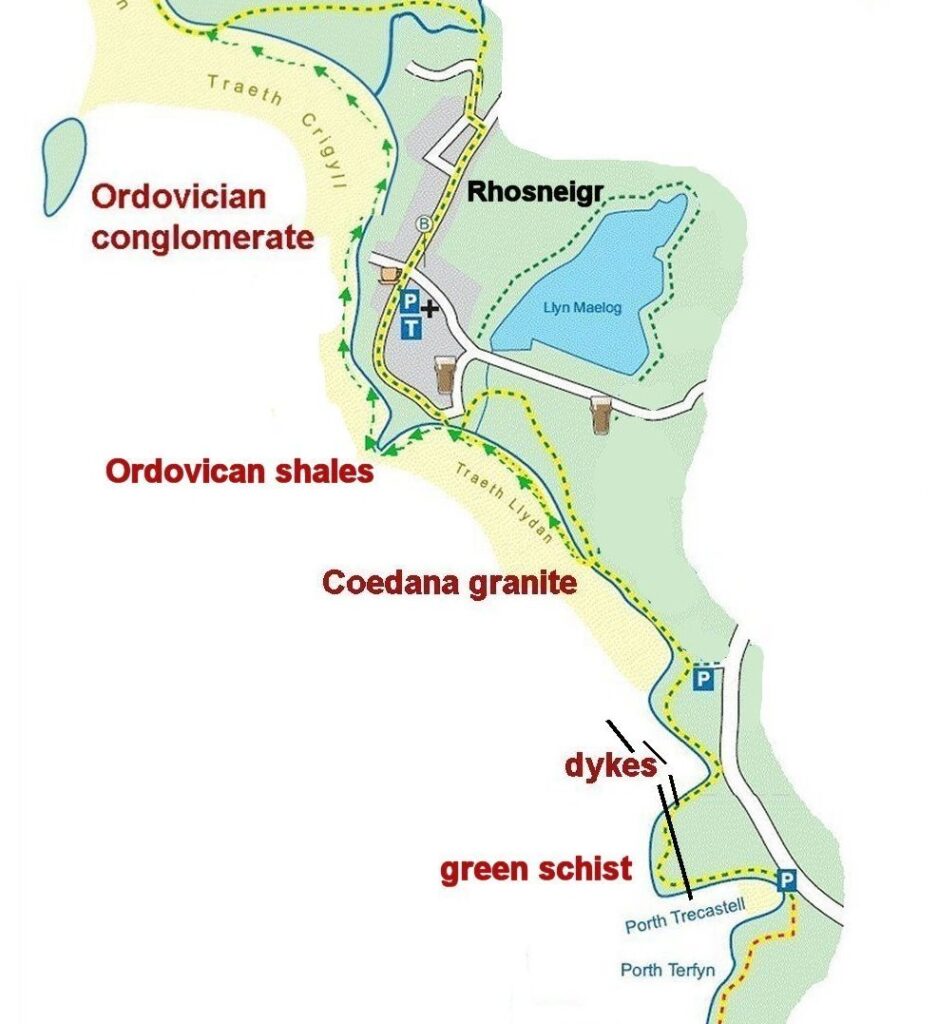
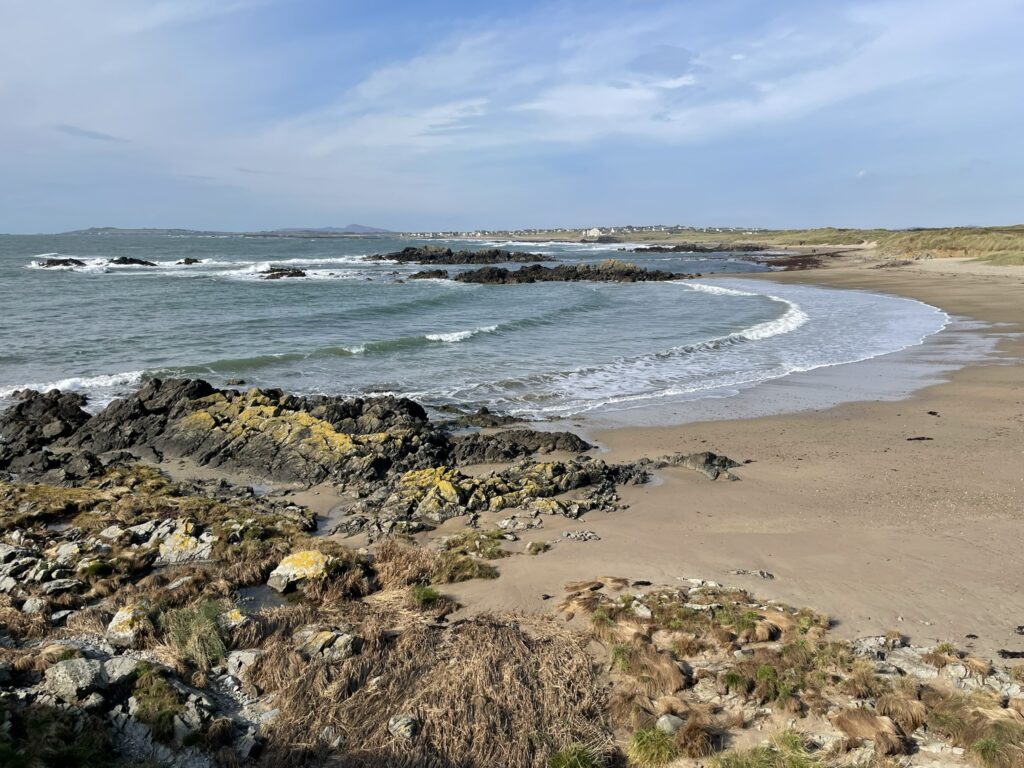
I love exploring the little rocky outcrops, islands at high tide but connected by pebbly causeways at mid tide, for two elusive rock types. Outlying stringers of coedana granite (from the main body inland near Gwalchmai) and tracing the dolerite dykes which cross the headland under the burial chamber and run discontinuously until we reach Traeth Llydan. On reaching the town of Rhosneigr some black, very thinly laminated rocks appear – I do like to follow the coast but often its much easier to take the road for a couple of hundred metres and come back to the shore opposite the group of rocky islands. These black rocks are Ordovician shales metamorphosed to a type of slate, the islands are composed of conglomerates, rocks full of pebbles! Along the beach between the shore and the islands there is a bed of peat in which fallen trees can often be found, dating back to shortly after the Ice Age. I’ve literally just walked across 1000 million years of Earth history (without even mentioning sand dunes and soil formation). Time to enjoy a coffee or panad in one of the excellent cafes in the town before walking back.